

When you’re a freelancer and you think about the money you’re losing, you tend to think of the big things: the client who doesn’t pay, the project that spirals out of control, the hours you underestimated. Everyone’s been there. But what’s cost me more over the years are two inconspicuous areas where money constantly trickles away without you even noticing.
The first is the time you don’t even track in the first place—all the non-billable work, client acquisition, admin, calls, and so on. I’ve written elsewhere about why a workday isn’t the same as a billable day. In short: If you don’t know how much of your time is actually being sold, you can’t decide whether to change anything about it.
The second area is much smaller and is therefore often overlooked: rounding.
It sounds like nitpicking, but it’s actually the exact opposite. A freelancer’s day often consists of many short entries—seven minutes here, eighteen there, just under half an hour somewhere else. If you just leave these crumbs as they are, you’ll end up with an invoice at the end of the month full of odd numbers that no one likes to discuss. If you round them off without thinking, you’re throwing them away. And if you round them one way one time and another way the next, you’ll end up with totals that don’t add up.
Rounding is really just a fair convention: For example, you bill in 15-minute increments, and both sides know where they stand. There’s just one important thing to keep in mind—and it’s surprisingly often done wrong—you round each entry individually and then add them up. Don’t add everything up first and then round the total. Otherwise, the individual items on the invoice won’t match the total, and that’s exactly what the customer will notice.
For me, it was never about trying to make more money, but about having a number I could write on an invoice with a clear conscience—one where every item is transparent and the numbers add up correctly in the end. That’s more important to me than any fancy statistic.
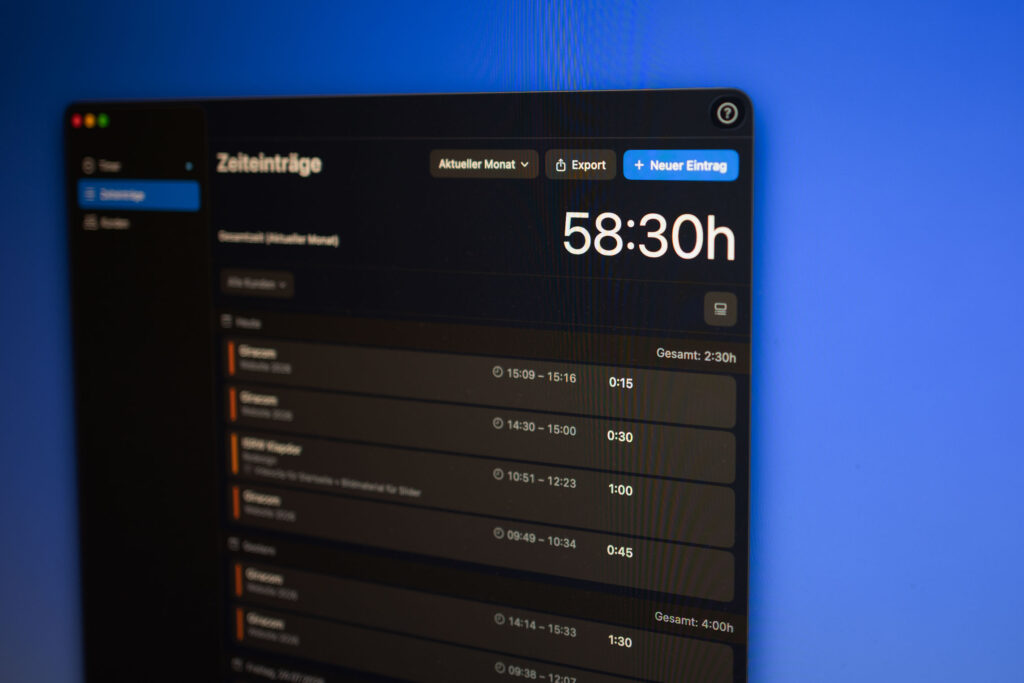
In Yokto, you set the rounding mode once—off, 5 minutes, 15 minutes, or a custom value—and each entry is rounded individually, then totaled. You don’t have to worry about it anymore in your day-to-day work; the numbers just add up correctly by the end of the day.
It’s nothing to brag about. But these two quiet leaks—the invisible time and the inaccurately rounded minutes—cost more over the course of a year than you might think. And you don’t plug them with discipline, but by first even noticing them in the first place.